

What a new AI report means for how you write a press release
A press release posted to GlobeNewswire in June had a 99.3% chance of surfacing in a ChatGPT or Claude answer within days of going live, according to a report Notified and PRWeek published this month.
GlobeNewswire is one of the major wire services companies pay to distribute news to media outlets, investors and now, increasingly, AI. Most new releases get their first AI reference within eight hours, the report found, with citation activity peaking around two weeks out and dropping off sharply after 45 days.
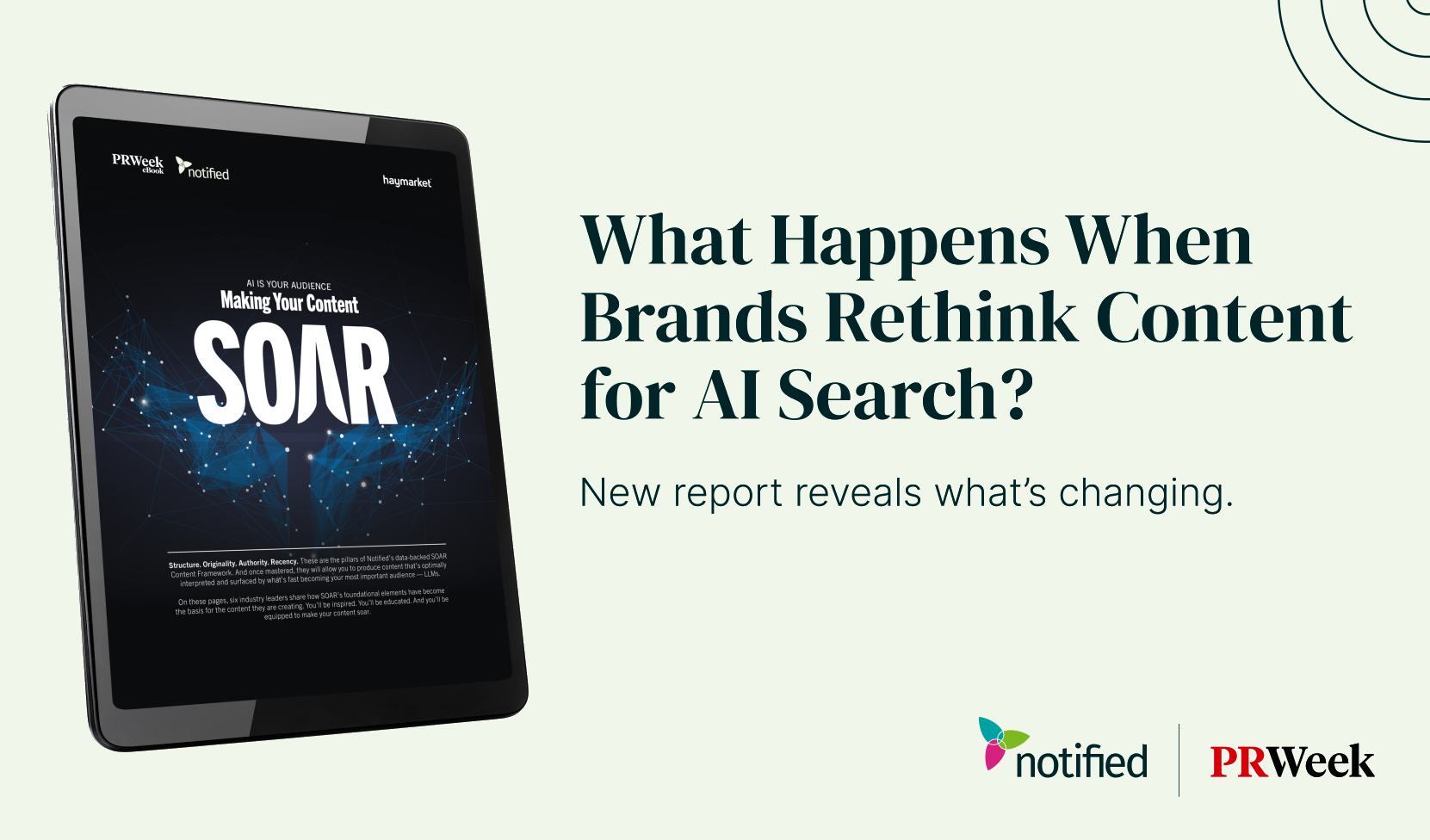
Promotional graphic for Notified and PRWeek's new report on AI search visibility, "AI Is Your Audience: Making Your Content Soar."
AI is becoming a primary way the public first encounters a company, ahead of a journalist, ahead of someone visiting a website. How a press release is written now measurably affects whether it gets seen at all. That's true no matter who's telling the story, which matters here because of who's telling this one.
The report, "AI Is Your Audience: Making Your Content Soar," comes from Notified, the company that owns GlobeNewswire, and PRWeek, a trade publication, built on Notified's own analysis of more than 250,000 press releases and nearly a quarter-billion AI citations.
Notified sells the wire distribution and AI optimization tools the report recommends, so this isn't independent research in the way a university study would be. It means the value is in the specifics, not the framing, so here is what's genuinely useful for a business trying to get this right.
The report's clearest, most repeatable lesson is one most communicators already know and routinely ignore: don't bury the lead. At Ally Financial, communications head Jackie Hartzell described building every release around three questions answered immediately, up front: what this is, why it matters and what to do about it, rather than easing into the news after a paragraph of throat-clearing. That's a newsroom habit, not an AI-era invention, but the report argues it matters more now because a machine deciding what to cite doesn't read past the parts that don't answer its question fast enough.
Specifics carry weight a generalization never will. Chipotle's communications team builds releases around concrete, named numbers, a stated "21M-plus members" figure, for instance, rather than vaguer language about growth or popularity. There's nothing for a machine to grab in a sentence like "growing fast." There's plenty in "21 million members."
The same principle shows up at Frantz Marketing Solutions, an agency working with smaller, independent clients, where founder Susan Frantz described testing every release against one question: could a competitor have written this using the same facts? If yes, she said, the release isn't ready. Releases built around genuinely original claims, not just competitor-swappable boilerplate, are notably more likely to be picked up, according to the report's research.
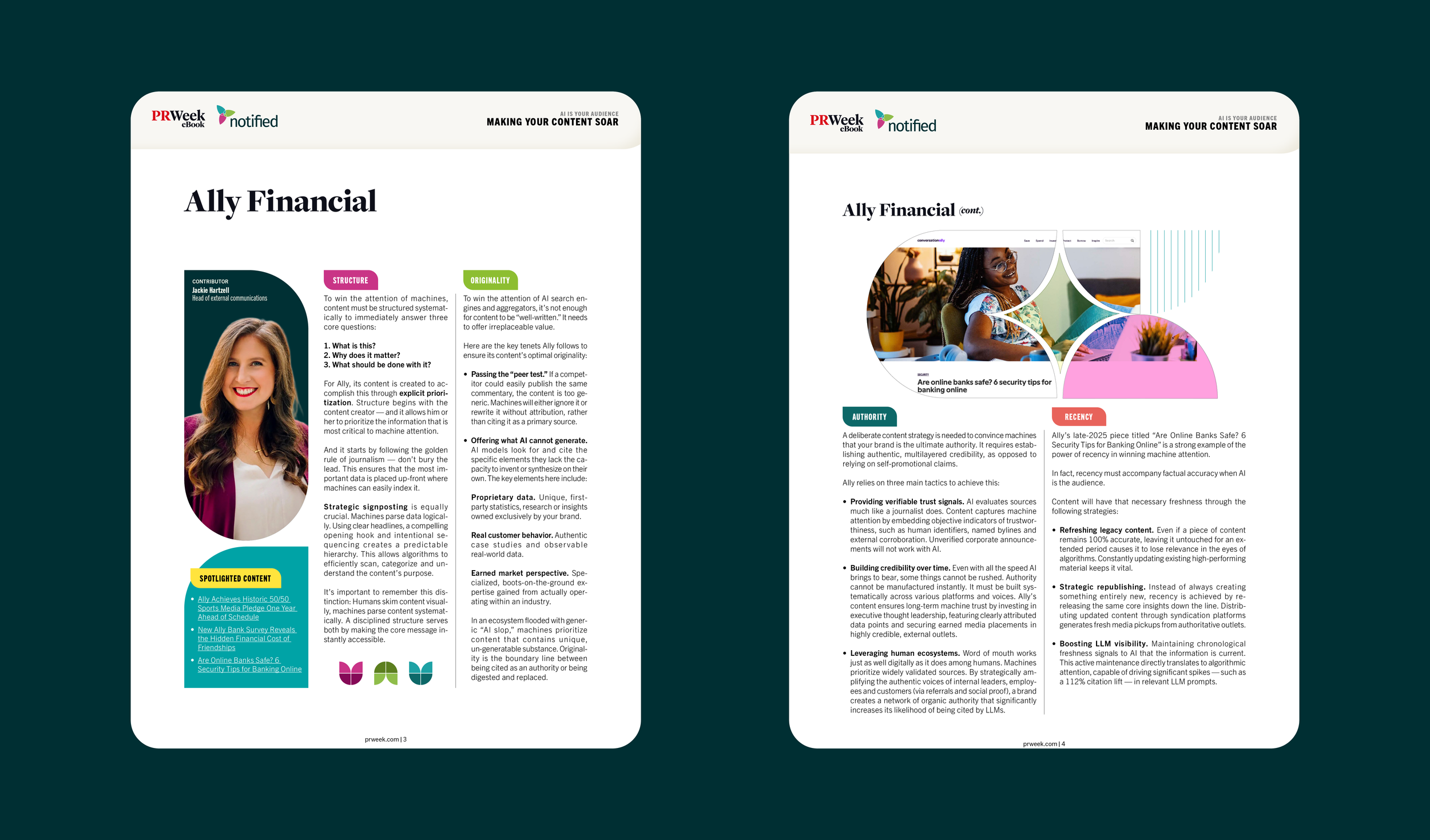
A spread from Notified and PRWeek's "AI Is Your Audience" report showing the Ally Financial case study, contributed by Jackie Hartzell, the company's head of external communications, covering the report's "structure," "originality," "authority" and "recency"
Ford's approach adds a different lesson: original material travels. Its "From the Road" content platform leans on firsthand reporting from inside its labs and manufacturing floors, material that can't be found anywhere else, and distributes original photography and data to journalists and creators directly, so that when that material gets reused elsewhere online, it can be traced back to Ford as the source.
Nestlé's contribution is less about any single release and more about upkeep. The company assigns a dedicated owner to every key web page specifically to keep it current, on the logic that even fully accurate information loses standing with AI systems if it sits untouched too long. That's a maintenance discipline more than a writing tip, but it may be the easiest one for a smaller organization to adopt, since it costs nothing beyond someone's attention.
Sandy Hook Promise offers the report's most distinct example. Rather than relying on existing public statistics, the organization commissioned its own original survey ahead of a campaign launch, giving AI systems, and journalists, a dataset that existed nowhere else. It's a more resource-intensive version of the idea running through every case study here: original information outperforms repackaged information, whether that's a firsthand story, a specific figure or a survey nobody else has.
Where this gets more complicated is what the report doesn't dwell on: getting a release in front of an AI system in the first place usually means paying to distribute it, and that isn't cheap.
A standard national release through PR Newswire, one of GlobeNewswire's main competitors, runs $805 to $1,070 for 400 words, on top of a mandatory annual membership of $195 to $249, with overages of $140 to $225 per additional 100 words. GlobeNewswire, Notified's own service, typically lands in a similar $900 to $1,200 range for a standard release. For a small business, that's a real cost to weigh against a single announcement.
Lower-cost options exist, EIN Presswire starts around $149 per release, PRWeb's basic tier runs $99, and NewswireJet advertises distribution from $129, though none carry quite the same institutional weight as the major wires. The report doesn't say whether AI models treat a $129 release any differently than a $900 one, a reasonable question a vendor-funded study has little incentive to chase down.
Other people have studied this too, and they don't all agree. A peer-reviewed study presented at the 2024 KDD conference, a major academic venue for data science research, with researchers from Princeton and Georgia Tech among others, found that structural signals like statistics, quotations and cited sources do measurably affect whether AI systems cite a source, which lines up with Notified's core argument.
But other independent research complicates the picture: an Ahrefs analysis of 75,000 brands found that mentions in independent, earned coverage correlate roughly three times more strongly with AI visibility than backlinks do, and separate findings from Moz and Muck Rack suggest AI systems favor earned, third-party coverage over brand-owned content more broadly. Put simply, how well a press release is written may matter less than whether an outside source is talking about the business at all.
That last point is where this report, built around owned content and paid distribution, misses something a lot of PR people learned a different way. The kind of public relations that holds up isn't the kind engineered to be picked up by anything, human editor or machine crawler, on the strength of formatting alone.
It's the kind built on being a credible source in the first place, the reputation a business earns before a single release ever goes out. A journalist deciding whether to run a story, and increasingly an AI system deciding whether to cite one, are both, in their own way, asking the same question: is this source trustworthy enough to repeat. Structure can help a true, well-sourced story get read. It can't manufacture credibility a business hasn't built.
That's a different discipline than optimization, and it's the one worth investing in first. It looks like relationships with real reporters who know a business well enough to call when something happens, built over years, not one release at a time.
It looks like a track record of releases that turned out to be accurate, so the next one gets the benefit of the doubt. It looks like naming a real, reachable person as the point of contact instead of a generic media inbox, because both journalists and, per the report's own findings, AI systems weigh verifiable, accountable sources more heavily than anonymous ones.
And it looks like restraint, saying less, more precisely, rather than dressing up routine news in language built to trigger a citation. A business that has genuinely earned coverage from reputable outlets, on the strength of a real story, gets cited by AI systems for the same reason a human editor picked it up: because there was something there worth repeating.
Structure a release the way the report describes: lead with the news, name real figures, keep it current. That costs nothing and is good practice regardless of whether an algorithm ever reads it. Weigh the wire distribution cost against the size of the news; a minor update probably doesn't need a $900 national release, while a genuinely significant announcement might.
But the bulk of the actual effort belongs somewhere the report spends little time: being covered, not just distributed, since the research on both sides of this argument agrees that earned attention outweighs owned content.
The best kind of public relations is still the old-fashioned kind: pick up the phone, tell a reporter something worth their time, and let them decide it's worth telling.