

Why every business needs a crisis communications plan
Michael Setzer was 32 years old when he reported for his shift at a Domino's Pizza franchise in Conover, North Carolina, on Easter Sunday in 2009. Before the day was over, he and fellow employee Kristy Hammonds had recorded a video that would cost them their jobs and thrust Domino's into one of the defining corporate reputation crises of the social media era, helping reshape how businesses across America think about crisis communications.
On the day in question, Setzer and Hammonds had recorded themselves contaminating food, including shoving cheese up Setzer’s nose before preparing a sandwich. They posted the footage to YouTube.
Within days, more than a million people had watched it. Television networks aired the videos. Health officials launched an investigation, and prosecutors later charged them with felony food tampering.
The Domino's episode is remembered not because two employees behaved recklessly. Businesses have always dealt with reckless employees. It's remembered because it arrived at the moment the rules changed. The internet had given ordinary people the ability to broadcast to millions, while most organizations were still communicating as if news traveled at the speed of tomorrow's newspaper. Nearly two decades later, that gap has only widened.
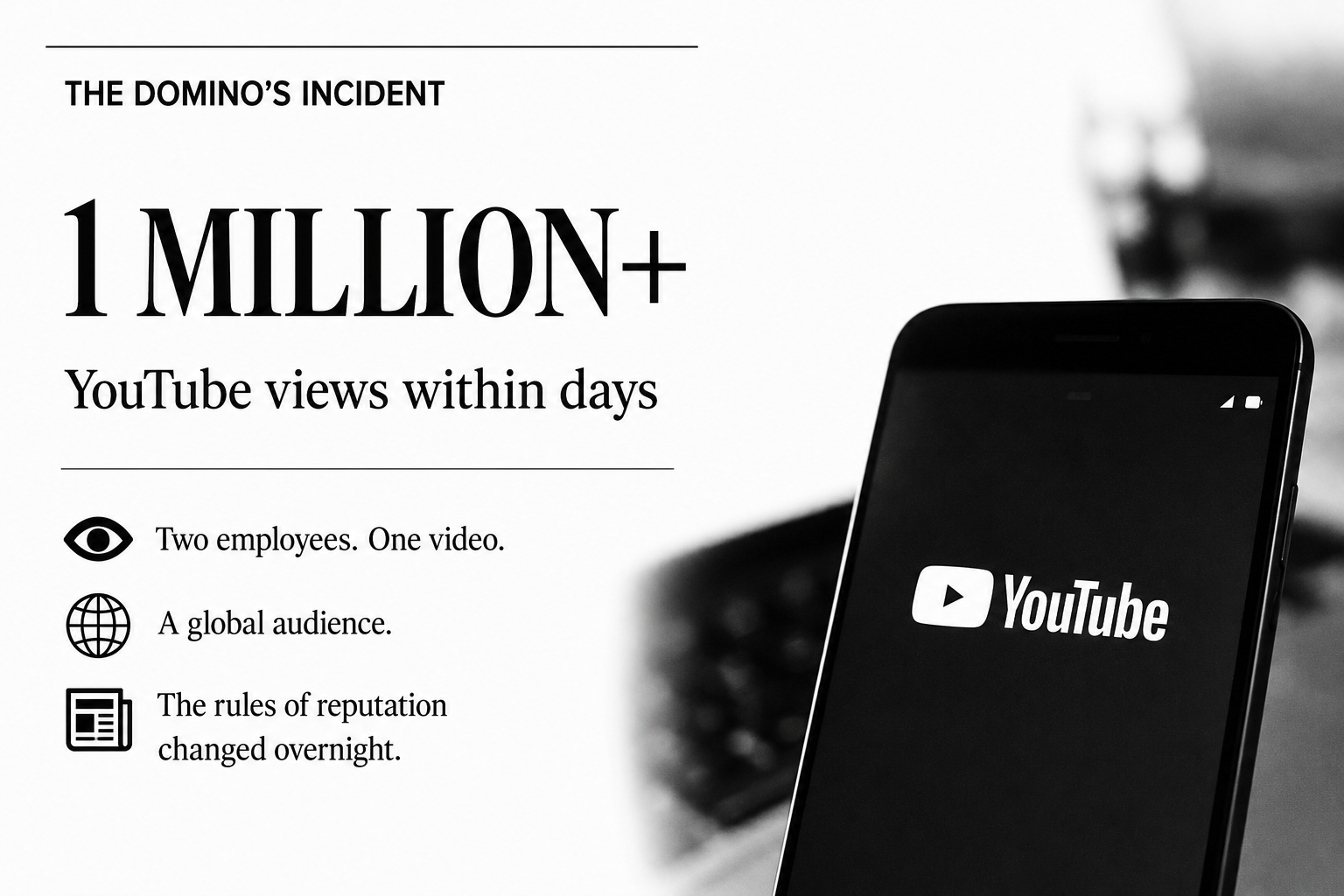
At first, Domino's treated the video as possible hoax and said almost nothing publicly, and in that silence the story stopped being about two employees and started being about the company that employed them.
Only once it was clear by midweek that the situation was escalating, did Domino's executives act by issuing an apology published to the company's website, launching a new Twitter account created specifically to address the incident and posting a personal video apology from president Patrick Doyle.
"We sincerely apologize for this incident," Doyle said. "We thank members of the online community who quickly alerted us and allowed us to take immediate action."
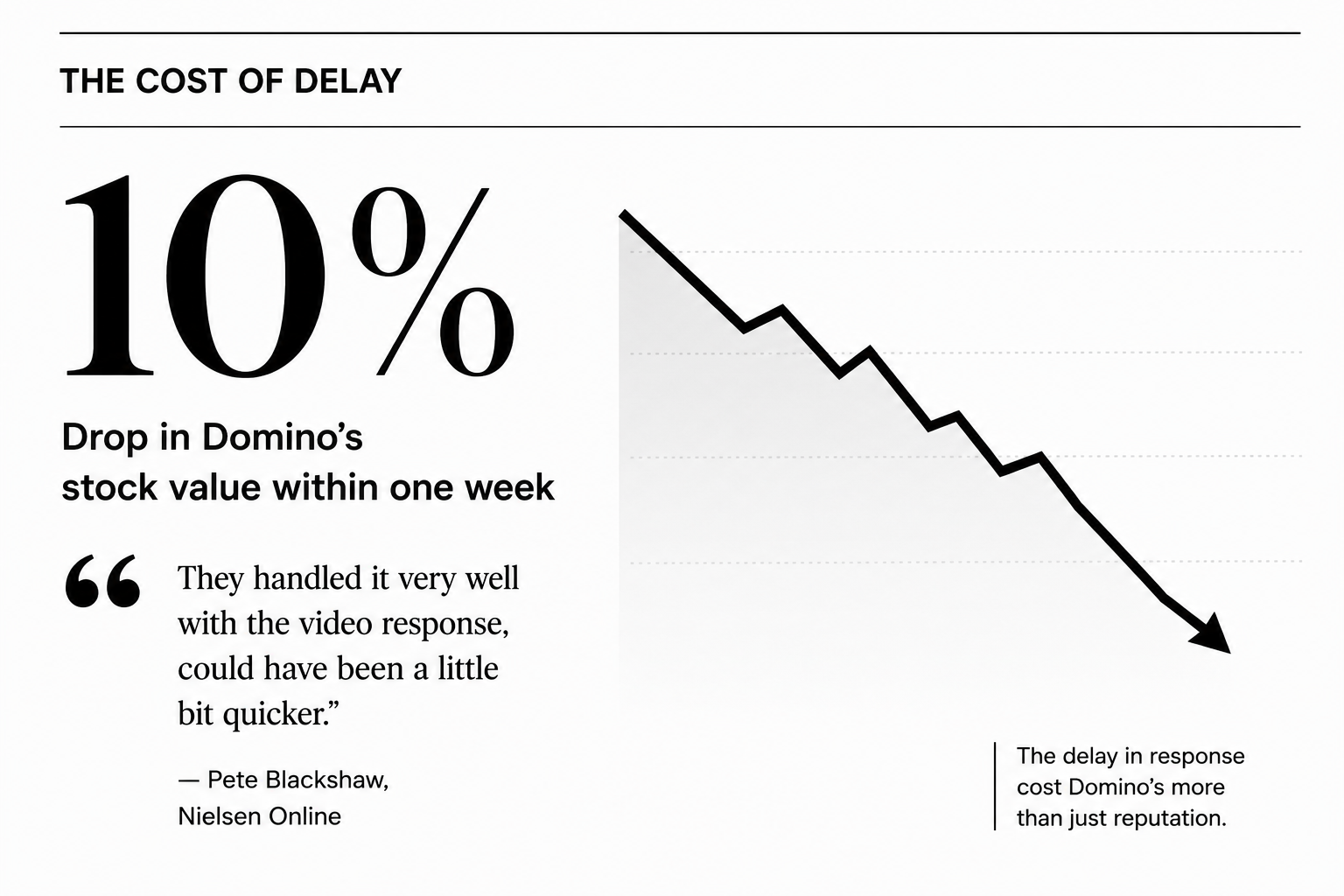
The response itself was, by most professional assessments, a good one. Pete Blackshaw, a brand strategist at Nielsen Online, told Time the company "handled it very well with the video response," though he noted it "could have been a little bit quicker."
That qualifier is the whole lesson. Domino's didn't lack the instinct to respond well once it acted, it lacked the readiness to act immediately, and immediacy is where a crisis is won or lost.
The delay triggered a 10% drop in the company's stock value within a week. And the irony, by the company's own admission, is that the infrastructure to respond quickly was almost already in place.
Domino's had assembled a social media team about a month earlier and was actively building a strategy to introduce the company to Facebook and Twitter, a plan they intended to launch only a week after the video surfaced.
"We ended up having to jump in [during] a crisis, which was the opposite of how we wanted to do it,” a dominos spokesperson later reflected.
A week. That's the entire distance between a brand that's prepared and a brand that's improvising in front of a million strangers.
Compare that to Johnson & Johnson in 1982, when cyanide-laced Tylenol capsules killed seven people in the Chicago area. There was no internal debate about whether to take it seriously.
Within a week, the company pulled 31 million bottles of Tylenol off shelves nationwide, at a cost of roughly $100 million, before any regulator forced their hand. Executives gave interviews. They communicated plainly and often, even while investigators were still working out what had happened.
Tylenol is still on shelves today. Decades of business school case studies point to that response as the reason why.
The difference between these two stories isn't the size of the crisis. Tylenol's was, witout a doubt, the worse one: deaths, a lethal product sitting in medicine cabinets. The difference is what existed before the crisis hit. Johnson & Johnson had the instinct and the infrastructure to decide fast. Domino's had both almost ready, and lost a week anyway.
What Covid-19 taught businesses about crisis communications
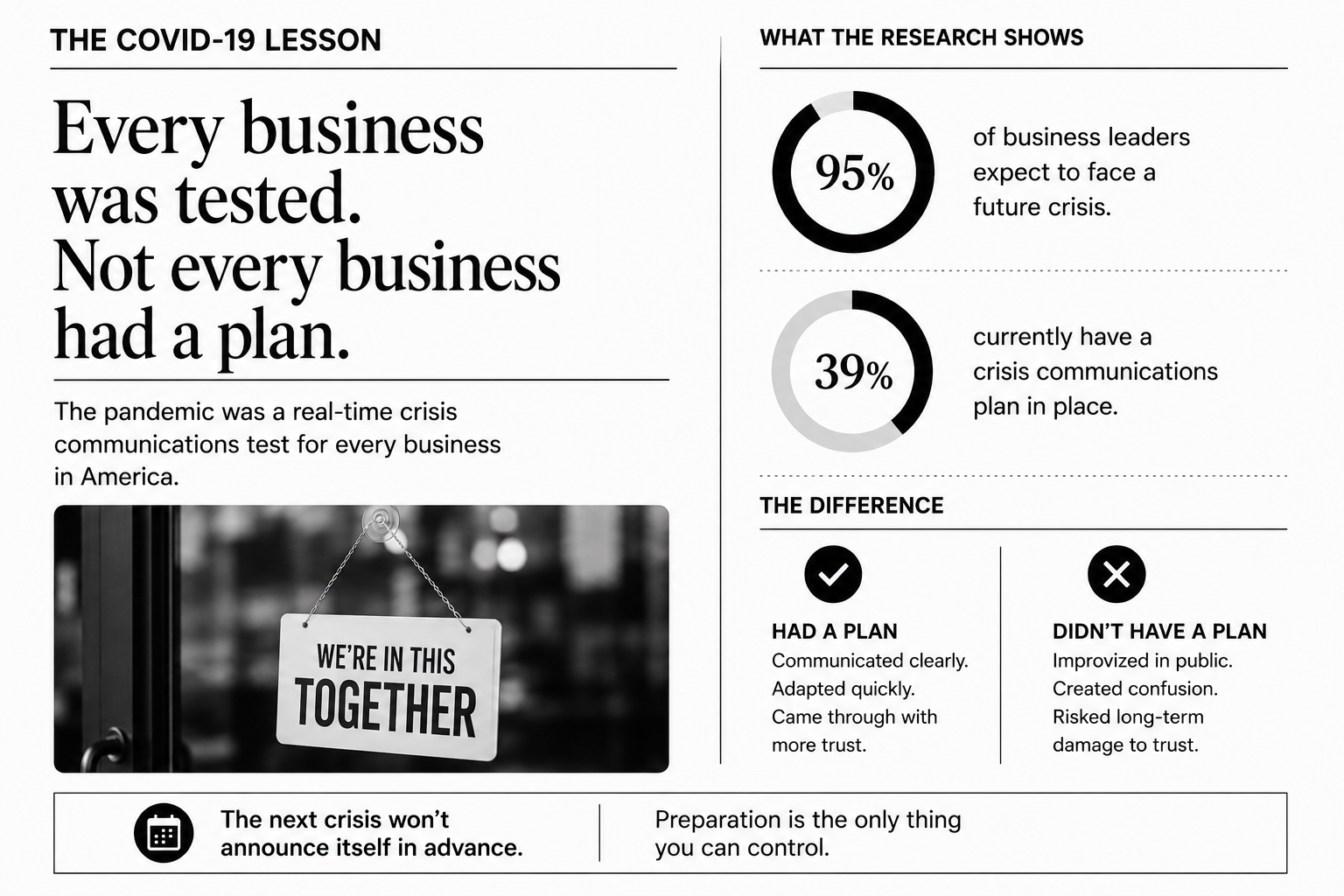
Here's what makes this more than a history lesson: if your business was open in 2020, you already lived through a real, simultaneous, industry-wide crisis. Every business owner in the country was tested on exactly this question, at the same time, with no warm-up.
Some had a plan, even an informal one. They communicated clearly and often with employees and customers, adapted quickly and came through with more trust than they started with.
A study of small business owner-managers conducted across 2020 found that the ones who communicated more closely and individually with their employees during the pandemic made their teams feel safer and less threatened, which strengthened cohesion straight through the crisis.
Separate research on retail and consumer service firms found that businesses willing to adapt and pivot their marketing and communications, rather than freeze, were the ones still standing on the other side.
Most businesses didn't have that plan and improvised in public for months. According to the Public Relations Society of America, 95% of business leaders expect to face a future crisis. Only 39% currently have a plan in place. If your business made it through 2020 without one, you got lucky on timing. The next crisis won't announce itself in advance the way a pandemic arguably did.
What belongs in a crisis communications plan
You don't need a legal department or a war room to have a real plan. Communications professionals generally build around the same handful of non-negotiables, and you can apply the same logic at small-business scale.
Before anything happens: decide who is allowed to speak for the business publicly, so the rest of your team knows to direct questions to that person instead of guessing. Draft a basic holding statement in advance, a few sentences that take a situation seriously without speculating, so you're never starting from a blank page under pressure. Identify your command center, even if it's just a shared document or a group text, so your team has one place to coordinate instead of scattering across five.
In the first hour after something happens: handle any immediate safety issue first, always. Tell your employees what's going on before the public finds out; they deserve to hear it from you, not from a customer's social media post. Then get a holding statement out fast, even before you have every answer. Silence is its own message, and it's rarely the one you want sent.
In the days after: follow through with real action. Acknowledge what happened. Explain what you're doing about it. Lay out what happens next. Tell people what support is available. And keep a record of what you said and when; it protects you, and it makes the next crisis easier, because you'll already know what worked.
None of this requires guessing right every time. It requires deciding these things on a calm Tuesday afternoon, not in the middle of the worst week your business has ever had.
Domino's spent a week finding out what that costs. The small businesses that came through 2020 with more trust than they started with already understood the lesson, even if nobody called it a crisis communications plan at the time. They just kept talking to people, plainly and often, instead of going quiet.
A crisis communications plan won't prevent a crisis. Domino's couldn't prevent two employees from recording a video. Johnson & Johnson couldn't prevent a criminal from poisoning Tylenol capsules. No organization could prevent a global pandemic.
What a plan can do is shorten the distance between the moment something happens and the moment leadership begins leading the conversation.
The businesses people remember aren't always the ones that avoided disaster. More often, they're the ones that responded with honesty and speed.
That's not something organizations come up with under pressure. It's something they decide before they need it.
If your organization hasn't made those decisions yet, that's where we come in.